
In an era where artificial intelligence and robotics are advancing at breakneck speed, the public is increasingly being introduced to humanoid robots not through dry technical specifications or laboratory demonstrations, but through spectacular live exhibitions that feel more like entertainment than engineering. From synchronized dance routines to martial arts performances and even boxing matches, humanoid robots are taking center stage in ways that are fundamentally reshaping how society perceives these machines. This shift from factory floors to public arenas represents a pivotal moment in the robotics industry, as companies race to prove that their creations are ready for real-world interactions and mass adoption.
The implications of these live exhibitions extend far beyond mere spectacle. They represent a sophisticated form of validation testing, marketing strategy, and public education that could determine the trajectory of the humanoid robotics industry for years to come. As we witness robots performing alongside humans in increasingly complex and demanding scenarios, the question is no longer whether these machines are capable of entertaining us, but whether we are ready to welcome them into our daily lives.
The Spectacle of Agibot Night: A Turning Point in Robotics Entertainment
Perhaps the most ambitious live humanoid robot exhibition to date was Agibot Night, a televised event held in Shanghai ahead of the Chinese Lunar New Year. This unprecedented showcase featured over 200 robots performing for a live audience of entirely robot spectators, in what the company described as the world’s first large-scale live event fully led by humanoid robots . The robots danced, boxed, performed martial arts, walked the runway in synchronized fashion routines, and even executed Shaolin-style stances while handling props such as fire torches .
What made Agibot Night particularly significant was its dual purpose as both entertainment and engineering validation. The event functioned as a high-pressure systems test playing out in public, where any stumble, delay, or synchronization error would have been broadcast to a global audience . In controlled lab environments, engineers can pause a machine, adjust parameters, and try again; live television offers no such luxury.
The robots behind this spectacular performance included Agibot’s G2 humanoid robots, which handled the bipedal routines including synchronized dance sequences, high-speed spins, and coordinated formations. These movements required precise joint control and real-time sensor feedback. The company’s D1 quadruped robots added dynamic stability to the lineup, showcasing agility and terrain adaptability . The stage also featured Agibot’s broader humanoid portfolio, including the full-sized A2 Series built for multimodal interaction and navigation, and the compact X2 Series designed for natural conversation and expressive movement .
During some segments, human dancers performed alongside the robots, with timing and alignment happening live, demonstrating how closely robotic motion can mirror human movement . One of the most talked about moments came from Elf Xuan, an ultra-realistic humanoid developed by AheadForm, whose facial expressions appeared strikingly lifelike during a singing performance .
The Strategic Significance of Live Robot Performances
The decision to showcase humanoid robots through live exhibitions rather than traditional product demonstrations represents a strategic shift in how robotics companies approach market introduction. For years, humanoid robotics advanced behind closed doors, with progress showing up primarily in research papers, factory trials, and controlled demonstrations. Agibot chose a different approach, turning engineering validation into a live cultural event that changed public perception .
When robots perform dance routines, hold martial arts stances, or coordinate fashion walks in front of a broadcast audience, they feel less like prototypes and more like machines designed for real-world environments. This strategy alters perception in ways that technical specifications cannot achieve. It normalizes the presence of robots in shared spaces and builds public familiarity that will be essential for widespread adoption .
The timing of these exhibitions is also strategic. Agibot Night took place ahead of the Chinese Lunar New Year, giving the production cultural weight as well as technical significance . The event served as a proof of concept for system-level reliability and a showcase of the company’s broader product ecosystem. The message was clear: these robots are no longer lab prototypes; they are entering large-scale production.
Agibot’s Market Position: Leading Global Shipments
Agibot is not a small player testing ideas on the sidelines. According to research firm Omdia, the company led global humanoid robot shipments in 2025, delivering 5,168 units out of roughly 13,000 shipped worldwide that year . For a company founded in 2023 in Shanghai, this represents a remarkably strong position in a fast-moving market.
While shipment totals show demand, a live event like Agibot Night demonstrates confidence. When robots perform for an hour straight, there is nowhere to hide. Motors heat up, sensors can drift, and software can glitch. When hundreds of machines move in sync, even small issues stand out immediately . By putting its robots on display ahead of a major national holiday, Agibot reinforced the idea that its humanoid robots have moved beyond experimentation and into scaled production.
Unitree’s Robot Boxing: Entertainment Meets Tourism Marketing
The concept of robots performing for public entertainment has extended beyond choreographed dance routines into competitive sports-style events. Unitree, a Chinese robotics company, is set to livestream what it claims will be the world’s first humanoid robot boxing match, titled “Unitree Iron Fist King: Awakening!” featuring its agile G1 robots .
This groundbreaking event blends sci-fi spectacle with cutting-edge technology while offering a unique opportunity for destination marketers to tap into China’s booming tourism market. The strategy involves creating 15-60 second videos on Douyin, China’s viral video platform with 800 million daily users, featuring Unitree’s G1 robots boxing at iconic destinations like Hangzhou or Zhangjiajie . This approach highlights how these tech marvels can complement modern, sustainable tourism while appealing to tech-savvy travelers.
The boxing match concept demonstrates how live robot performances can serve multiple purposes simultaneously. For the robotics company, it provides a high-profile demonstration of the robot’s balance, agility, and durability under demanding conditions. For tourism marketers, it offers a compelling spectacle that can attract visitors and generate social media engagement. This convergence of technology and entertainment represents a growing trend where humanoid robots become attractions in their own right.
LimX Luna: The Performance-Oriented Humanoid
While many robotics companies focus primarily on industrial applications, LimX Dynamics has taken a different approach with its Luna humanoid robot. Rather than competing in the factory automation space, Luna was presented as an interactive performer a kind of “boundless art” in flowing movement . The robot was designed specifically for the entertainment market, a strategic pivot that recognizes the growing demand for robotic performers in events, shows, and public spaces.
Luna stands 160 cm tall, weighs 54 kg, and features a design aesthetic that emphasizes “approachable aesthetics” rather than industrial charm . Under the hood, however, the robot is thoroughly capable, driven by a second-generation “Sys 0” Motion Engine with improved joint motors and 27 degrees of freedom. This enables advanced maneuvers including side somersaults and the impressive Iljuschin spin .
What sets Luna apart is its “Video to Motion” feature, which allows users to simply upload a video of a dancing human, and the robot’s AI analyzes the movements and replicates them in real-time . Combined with kinesthetic programming and an AI task editor, the barrier to creating complex choreography drops from weeks of coding to a simple voice command. This user-friendly approach opens up robotic performance creation to non-experts, potentially democratizing the use of robots in entertainment.
The true showstopper is the swarm control capability, where a single operator can synchronize and control a troop of over 200 Luna units with millisecond precision . This opens up possibilities for massive, visually stunning robot performances at opening ceremonies, concerts, or theme parks.
The pricing positions Luna in a professional category significantly above toy level but affordable for businesses in the event and entertainment sector. The launch price in China is approximately 40,500 euros, with an introductory offer of around 35,800 euros for the first 100 units . For comparison, LimX’s more research-focused “Oli EDU” platform is listed at nearly 56,500 euros.
Boston Dynamics Atlas: From Lab Demonstrations to Stadium Spectacles
Boston Dynamics, now owned by Hyundai Motor Group, has long been known for impressive robot demonstrations, but the company is increasingly moving toward real-world applications. In a recent demonstration, the Atlas humanoid robot showed it could lift and move a 23 kg mini fridge, a task requiring full-body control and sophisticated balance management .
The video of this demonstration showed Atlas bending its knees halfway before lifting the refrigerator using both arms, maintaining balance while carrying the appliance, rotating its upper body 180 degrees, and carefully placing the refrigerator onto a table . This may seem simple for a human, but for a robot, it represents a significant milestone in full-body control capabilities.
According to Boston Dynamics, the robot learned these movements through large-scale simulation-based reinforcement learning and successfully transferred those skills into real-world environments within weeks . The reinforcement learning process involved repeated cycles of success and failure in virtual environments to optimize movements for real industrial settings. Through this training, Atlas was able to transport not only a 23 kg refrigerator but also larger models weighing up to 45 kg .
The company is developing Atlas with commercialization in mind, designing the robot for higher performance and easier compatibility. Actuators have been standardized into two types, while both arms and legs share identical structures to simplify maintenance and component replacement . Hyundai plans to deploy Atlas robots at manufacturing facilities by 2028 and produce up to 30,000 units annually by 2030 .
Atlas made an even more spectacular public appearance during the knockout stages of the FIFA World Cup 2026, performing at halftime in New York/New Jersey Stadium . The robot emerged from the player entrance tunnel and executed synchronized movements, perfectly mimicking the signature goal celebrations of renowned soccer icons including Son Heung-min and Harry Kane . The demonstration served as a practical test of real-time mechanics and dynamic balance, with Atlas utilizing its precise navigation, locomotion, and grip-control systems to safely retrieve the official tournament match ball and hand it over to the head referee .
This stadium demonstration served as a massive proof-of-concept for Hyundai, showing how close autonomous humanoid machines are to safely interacting within everyday human environments .
The Scientific Community Perspective: ICRA 2026 Robot Parade
The robotics research community has also embraced the concept of live robot demonstrations through events like the Robot Parade at ICRA 2026. ICRA (the IEEE International Conference on Robotics and Automation) is one of the largest and most prestigious robotics and automation conferences in the world, bringing together leading researchers, robot manufacturers, universities, and technology companies .
One of the highlights this year was the Robot Parade, where robots from different companies and research groups marched through the exhibition area, demonstrating their capabilities to attendees. Events like this provide a much better picture of the state of the industry than isolated marketing videos. When robots are seen side by side, operating in the same environment, it becomes much easier to understand who is leading, what challenges are being solved, and where the market is heading .
While a robot parade is, of course, a piece of theatre, it also serves a diagnostic function. A parade compresses years of capital expenditure, hiring, and architectural bets into a 30-second walk. Observers can see who can stand, who can recover, who moves among humans without a safety cage, and who quietly stays in the booth . The real signal lies in which platforms keep showing up, edition after edition, with fewer cables and fewer handlers. The question for anyone tracking the field beyond the highlight reels is which humanoids will still be relevant at future conferences, and which were essentially funding rounds on legs .
The World Intelligence Expo: China’s Robot Extravaganza
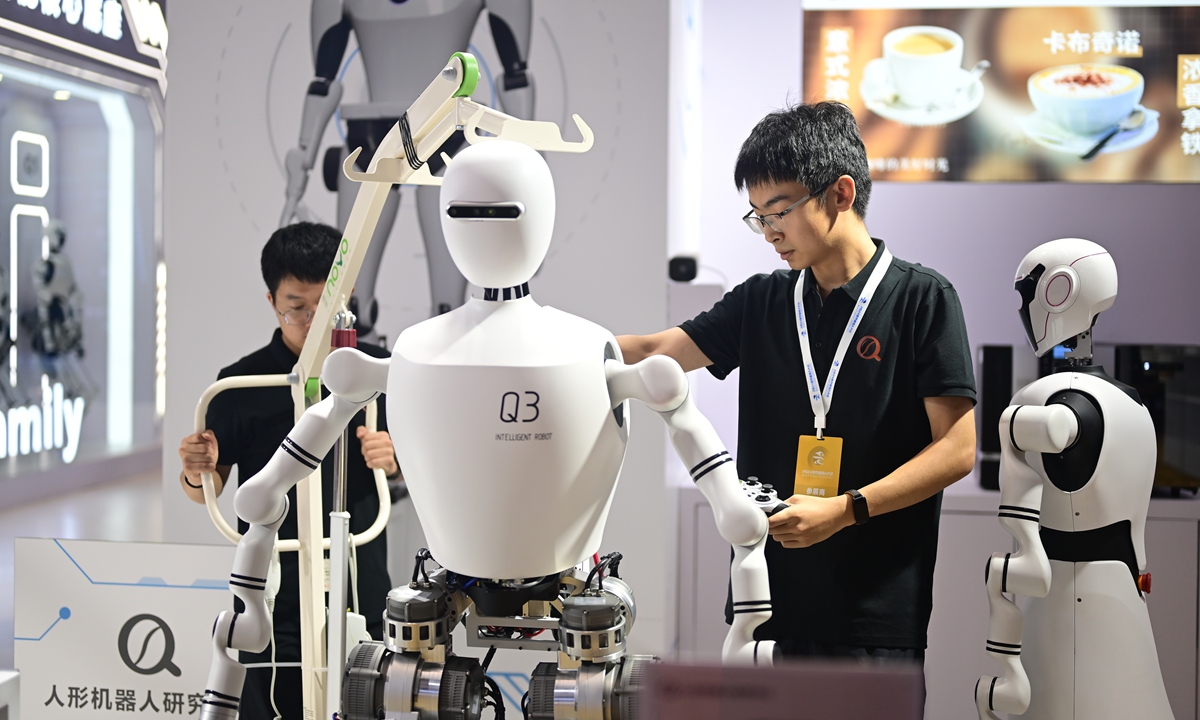
China has emerged as a major hub for live robot exhibitions, with events like the World Intelligence Expo in Tianjin showcasing the latest developments in humanoid robotics. At the 2026 expo, a humanoid robot band played music at the opening ceremony, and visitors could interact closely with robots in both indoor immersive displays and outdoor live performances .
One major highlight was the Intelligent Robot Carnival, spanning 17,000 square meters at Tianjin Cultural Center, which was described as China’s first large-scale all-outdoor comprehensive robot gala . The carnival abandoned conventional indoor exhibition modes in favor of an open, boundless tech venue where visitors could stand right next to robot demonstrations and observe every detail up close.
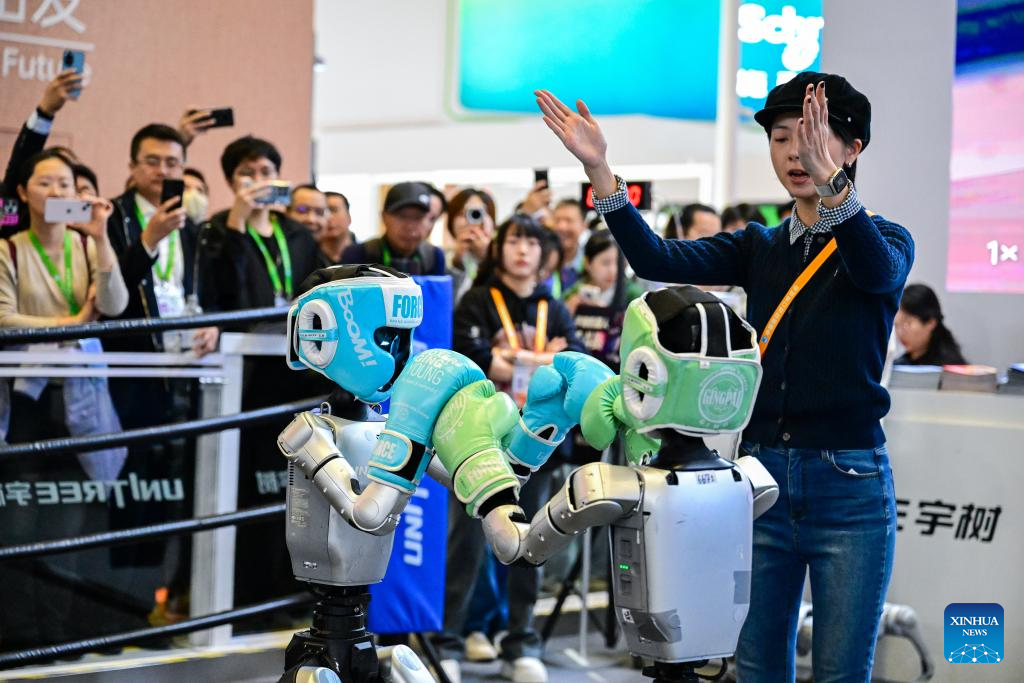
Operators used virtual reality to remotely control humanoid robots for live boxing matches, winning warm applause from spectators . A robot welcoming squad waved and turned in precise unison, shifting formations following music beats . Shiyun Technology displayed a full lineup of humanoid robots capable of group choreography, delivering all-round performance solutions for scenic spots, museums, and galas .
The expo also highlighted the potential of AI and robotics in cultural tourism. Experts noted that AI demonstrates great adaptability for large-scale conservation, inheritance, revitalization, and utilization of cultural relics as well as natural and cultural resources . The integration of cutting-edge technology with tourism experiences was seen as a way to brand Tianjin as a renowned smart city.
The Korea Science Festival: Robots in Everyday Life
The 2026 Korea Science Festival, held at KINTEX in Ilsan, showcased how robots are becoming integrated into everyday life. One of the most impressive demonstrations featured two humanoid robots trading punches in a boxing match, wearing gloves and regaining balance after taking hits, reminiscent of the movie ‘Real Steel’ .
The exhibition also featured transformable robot furniture developed by the Korea Institute of Science and Technology (KIST). This space-saving technology changes shape from a chair to a mini-table, a large dining table, a storage box, and a cart simply by shrinking or expanding . This demonstrates how robotic technology can enhance everyday living spaces in ways beyond entertainment or industrial applications.
The festival’s slogan, “Imagination, Becomes Reality: A Changed Daily Life, An Approaching Future,” encapsulates the broader vision of how robotics and AI are transforming society. The event was organized by the Ministry of Science and ICT, along with the Korea Foundation for the Advancement of Science and Creativity and the National Research Foundation of Korea, highlighting government support for public engagement with technology .
The Education and Public Engagement Dimension
Live robot exhibitions serve an important educational function, particularly for younger generations. At the World Intelligence Expo, children got up close to cutting-edge AI technologies under staff guidance, with displays including a six-rotor aircraft, self-balancing motorcycle, firefighting robotic dog, and inspection robot . Staff hosted popular science activities at the cultural center to spark kids’ interest in science and technology, helping the public understand how research goes beyond academics to tackle core industrial challenges.
The Korea Science Festival similarly focused on “everyday life technologies” that visitors could directly touch and experience, emphasizing accessibility and hands-on engagement . These events make advanced technologies easy and fun for ordinary visitors, with international students at the expo describing the experience as “incredibly fulfilling and eye-opening” .
Beyond the Spectacle: What Live Exhibitions Reveal
While the spectacle of hundreds of robots performing synchronized routines or boxing matches captures public attention, these live exhibitions reveal deeper insights about the current state of humanoid robotics.
First, they demonstrate the growing maturity of robotic hardware. The ability to maintain balance, execute complex movements, and coordinate with other robots in real-time requires sophisticated sensors, actuators, and control systems. The fact that companies can stage hour-long performances without significant failures indicates that fundamental hardware challenges are being solved.
Second, they highlight advances in AI and software. The transition from pre-programmed routines to AI-driven movements that can adapt to changing conditions represents a significant leap forward. The ability to upload a video of a human dancing and have a robot replicate those movements in real-time suggests that the gap between human and robotic movement is narrowing.
Third, they reveal the strategic priorities of different companies. Agibot’s focus on synchronized group performances suggests a strategy oriented toward public events and entertainment applications. Boston Dynamics’ emphasis on industrial tasks like moving refrigerators indicates a focus on factory and logistics applications. LimX’s performance-oriented Luna suggests a bet on the entertainment market. Each company is positioning itself for different market segments.
Fourth, they serve as validation testing. There is no better way to test a robot’s reliability than to put it on public display where failures will be immediately visible. Companies that are confident enough to stage public performances are signaling that they believe their technology is ready for commercial deployment.
Challenges Remain
Despite the impressive progress demonstrated by live exhibitions, significant challenges remain before humanoid robots become commonplace in everyday life.
Safety remains a primary concern. When robots operate in close proximity to humans, the risk of injury must be addressed. LimX’s four-level safety architecture, which includes active fall mitigation, external force sensors that immediately stop operation during a collision, and emergency stop buttons, represents one approach to this challenge .
Battery life and endurance are ongoing limitations. While LimX boasts about 4 hours of wireless performance, this is insufficient for most practical applications . Robots that need to operate for full work shifts will require longer battery life or the ability to swap batteries quickly.
Cost remains prohibitive for many applications. With prices ranging from tens to hundreds of thousands of dollars, humanoid robots are still too expensive for mass adoption. Reducing costs while maintaining performance will be essential for widespread deployment.
Reliability in unpredictable environments is unproven. While robots can perform well in carefully staged exhibitions, real-world environments are far more variable and unpredictable. The question of how these robots will perform in messy, noisy, and dynamic settings remains open.
Social acceptance is an evolving challenge. The uncanny valley effect, where robots that look almost human but not quite cause discomfort, remains a barrier for some applications. Additionally, concerns about job displacement and the social implications of widespread robot adoption will need to be addressed.
The Future of Humanoid Robot Live Exhibitions
The trajectory of humanoid robot live exhibitions suggests several directions for the future:
Increased scale and complexity. As companies gain confidence in their technology, exhibitions will likely become more ambitious, incorporating more robots, more complex movements, and more challenging environments.
Integration with major events. The Atlas performance at the World Cup halftime show represents a new frontier for robot exhibitions. As robots become more sophisticated, they may become regular fixtures at major sporting events, concerts, and cultural celebrations.
Interactive experiences. Rather than simply watching robots perform, audiences may increasingly be able to interact with them, creating personalized experiences and engaging in collaborative activities.
Competitive events. Robot boxing matches, dance competitions, and other competitive events could emerge as popular entertainment formats.
Educational applications. The educational value of robot exhibitions will likely be recognized and expanded, with programs designed to inspire interest in STEM fields.
Commercial deployment. The confidence gained through successful public exhibitions will accelerate commercial deployment in sectors including entertainment, hospitality, retail, and healthcare.
Conclusion
The era of humanoid robot live exhibitions represents a pivotal moment in the robotics industry. These spectacular displays are far more than entertainment; they are sophisticated testing grounds, marketing platforms, and educational tools that are reshaping public perception of robots. Companies like Agibot, Unitree, LimX Dynamics, and Boston Dynamics are demonstrating that humanoid robots are ready to leave the laboratory and enter the public sphere.
The strategic significance of these exhibitions cannot be overstated. By turning engineering validation into live cultural events, robotics companies are building public familiarity and acceptance that will be essential for widespread adoption. At the same time, these exhibitions provide invaluable data on robot performance under real-world conditions, accelerating the development cycle and identifying areas for improvement.
As we witness robots performing increasingly complex and demanding tasks in public spaces, the question is no longer whether humanoid robots will become part of our daily lives, but rather when and in what form. The spectacle of 200 robots dancing in perfect synchronization or a robot boxing in a ring may seem like science fiction, but it is rapidly becoming science fact. The humanoid robot revolution is not coming; in many ways, it has already arrived.