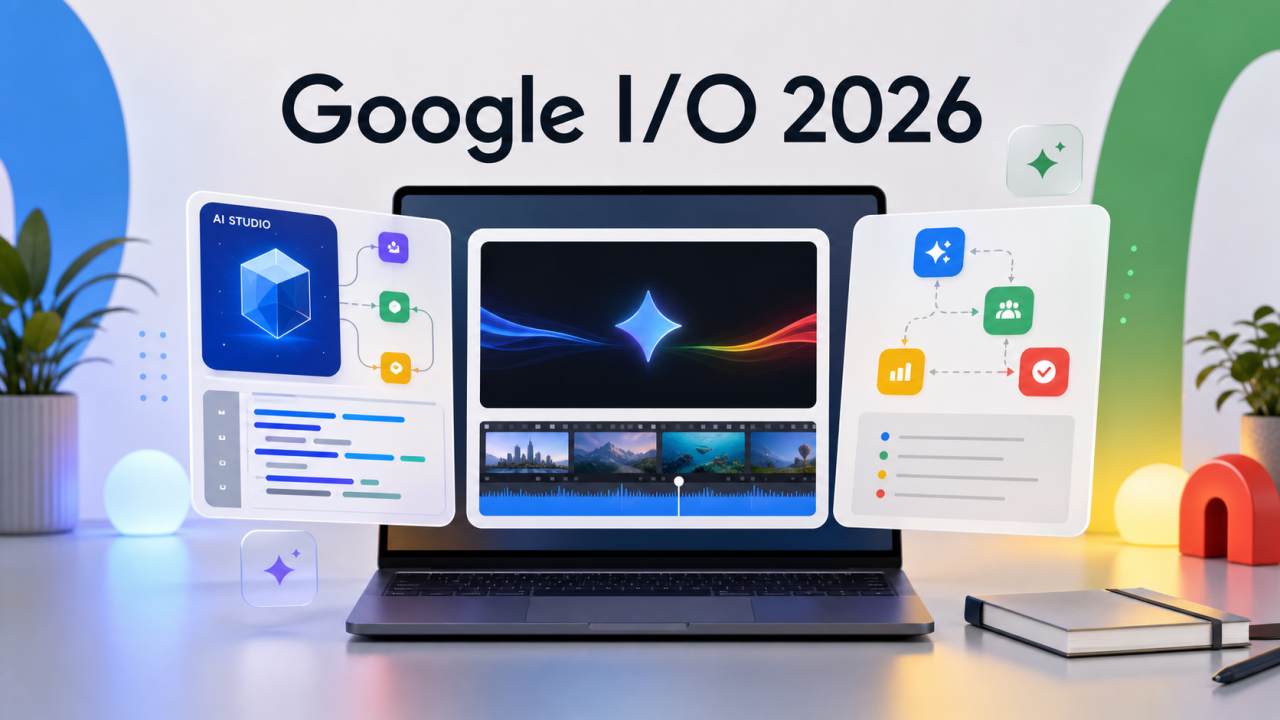
On May 19 and 20, 2026, technology enthusiasts, developers, and industry analysts from around the globe turned their attention to Mountain View, California, as Google hosted its annual developer conference, Google I/O 2026. What unfolded over those two days was nothing short of a tectonic shift in the artificial intelligence landscape. Google CEO Sundar Pichai took the stage to declare the dawn of what he called the “Agentic Gemini Era” a fundamental transformation in how artificial intelligence would interact with users, moving from passive chatbots that merely respond to questions into proactive digital agents capable of autonomous action.
Ten years after Google pivoted its entire corporate strategy to become “AI-first,” Pichai emphasized that the company still views artificial intelligence as the most profound way to advance its mission and improve people’s lives at scale. The 2026 I/O keynote made it abundantly clear that Google is no longer content with AI that simply assists; the company is now fully committed to AI that acts. From search and workspace productivity to Android, YouTube, cloud infrastructure, and developer platforms, artificial intelligence has become deeply embedded across Google’s entire ecosystem.
The numbers presented during the keynote painted a picture of explosive growth and unprecedented scale. Google revealed that its model APIs are now processing roughly 19 billion tokens per minute, with total monthly token processing across all AI-powered products and services exceeding 3.2 quadrillion a staggering sevenfold increase from the 480 trillion tokens processed at the time of the previous year’s I/O. The Gemini app, which had 400 million monthly active users at I/O 2025, has now crossed the 900 million user milestone. More than 8.5 million developers are now building applications using Gemini models every month.
This comprehensive analysis explores the most significant announcements from Google I/O 2026, examining how the company’s aggressive push into agentic AI is reshaping the technological landscape and what these developments mean for businesses, developers, and everyday users.
Part I: The Agentic Gemini Era A Paradigm Shift
A. From Prompts to Action
The central theme of Google I/O 2026 was unmistakable: the company is accelerating the shift from prompts to action. Rather than functioning as sophisticated chatbots that generate text responses, AI agents are now designed to independently navigate complex tasks across entire workflows. This represents a fundamental philosophical shift in how Google conceptualizes artificial intelligence.
Josh Woodward, Vice President of Google Labs, Gemini App, and AI Studio, articulated this transformation clearly when discussing Gemini Spark: “Spark represents a big shift for Gemini, transforming it from an assistant that can answer your questions into an active partner that does real work on your behalf and under your direction”. This sentiment was echoed throughout the conference, with the word “agent” attached to nearly every product shown on stage.
The distinction between traditional AI assistants and agentic AI is crucial. Traditional assistants respond to queries with information or generated content. Agentic AI, by contrast, takes initiative it plans, executes, iterates, and delivers outcomes. As Google DeepMind CTO Koray Kavukcuoglu explained, this represents a move from predictive text to simulating reality. The company’s goal for 2026 is to put AI agents at the forefront of all its biggest services: Search, Gmail, YouTube, Docs, and the Chrome browser.
B. The Full-Stack Approach to AI Innovation
Google’s strategy for achieving this agentic vision relies on what Pichai described as a differentiated, full-stack approach to AI innovation. This encompasses everything from custom silicon and secure infrastructure to world-class research and models, to products and platforms that touch billions of people. The company’s massive capital expenditure of approximately $180 billion to $190 billion in 2026 up from $31 billion in 2022 reflects the scale of this commitment.
The full-stack approach enables Google to innovate and iterate across every layer of the technology stack simultaneously, from the underlying hardware to the user-facing applications. This vertical integration strategy was on full display throughout the I/O 2026 keynote, as announcements spanned custom TPU chips, foundational AI models, developer platforms, and consumer applications.
C. The Infrastructure Behind the Agents
Supporting the agentic vision requires massive computational infrastructure. Google’s eighth-generation Tensor Processing Units (TPUs), announced prior to I/O at Google Cloud Next ’26, represent the hardware backbone of this new era. The company adopted a dual-chip strategy for the first time, with TPU 8t optimized for large-scale pre-training and TPU 8i designed for high-performance inference.
The TPU 8t delivers nearly three times the raw computational power of its predecessor, enabling massive model training tasks to be distributed across more than one million TPU nodes worldwide. What previously required months of training time can now be compressed into weeks. The TPU 8i, meanwhile, is equipped with 384MB of SRAM and 288GB of HBM3e memory, optimized for cost-effective inference at near-zero latency.
These hardware advances are essential for supporting the agentic workloads that Google envisions. As the company processes 19 billion tokens per minute and serves over 900 million Gemini users monthly, the efficiency gains from custom silicon translate directly into improved performance and reduced costs for both Google and its customers.
Part II: Gemini 3.5 The New Foundation for Agentic AI
A. Gemini 3.5 Flash: Speed Meets Intelligence
The flagship model announcement at Google I/O 2026 was the launch of Gemini 3.5 Flash, the first model in the Gemini 3.5 series. This model represents a significant advancement in combining frontier intelligence with exceptional speed. Gemini 3.5 Flash outperforms the previous Gemini 3.1 Pro across almost all benchmarks while running approximately four times faster than other frontier models.
The performance metrics are impressive. On Terminal-Bench 2.1, a challenging agentic terminal coding benchmark, Gemini 3.5 Flash scored 76.2%, significantly ahead of Gemini 3.0 Flash (58%), Gemini 3.1 Pro (70.3%), and Anthropic’s Claude Opus 4.7 (66.1%), though slightly behind OpenAI’s GPT-5.5 (77.2%). On MCP Atlas, it achieved 83.6%, and on GDPval-AA it scored 1656 Elo. In multimodal understanding, it maintained leadership with a CharXiv score of 84.2%.
What makes Gemini 3.5 Flash particularly compelling is its positioning in the Artificial Analysis index, where it landed in the top-right quadrant delivering frontier-level intelligence at exceptional speed. This demonstrates that users no longer have to trade quality for latency. The model is ideal for tackling long-horizon agentic tasks that previously required days of developer work or weeks of auditor review; Gemini 3.5 Flash can now help complete these tasks in a fraction of the time, often at less than half the cost of other frontier models.
Google DeepMind designed these models from the ground up using infrastructure built specifically for AI, employing a unique co-design approach between models and hardware that enables faster and more efficient training of deeper reasoning capabilities with each new generation.
B. Gemini 3.5 Pro on the Horizon
While Gemini 3.5 Flash became generally available immediately at I/O, Google also confirmed that work is progressing on Gemini 3.5 Pro. The larger model is already being used internally, and the company looks forward to rolling it out in the month following the conference. This two-tier approach offering both a high-speed Flash version and a more powerful Pro version mirrors the strategy Google has employed with previous Gemini releases, allowing developers and users to choose the model that best fits their specific needs and constraints.
C. Multimodal Capabilities and Real-World Applications
Gemini 3.5 Flash builds on the strong multimodal foundation of Gemini 3, generating richer and more interactive web UIs and graphics. The model demonstrates particular strength in multistep workflows, real-world general tool use, financial analysis, information synthesis from complex charts, and multimodal reasoning.
For developers, this means the ability to rapidly plan, build, and iterate to solve real-world problems, whether developing new applications, maintaining codebases, or helping prepare financial documents. For enterprises, the model’s capabilities translate into increased productivity and reduced operational costs. The cost efficiency is notable Gemini 3.5 Flash typically costs less than half the price of other comparable models.
Part III: Gemini Omni Creating Anything from Any Input
A. A New Paradigm for Generative AI
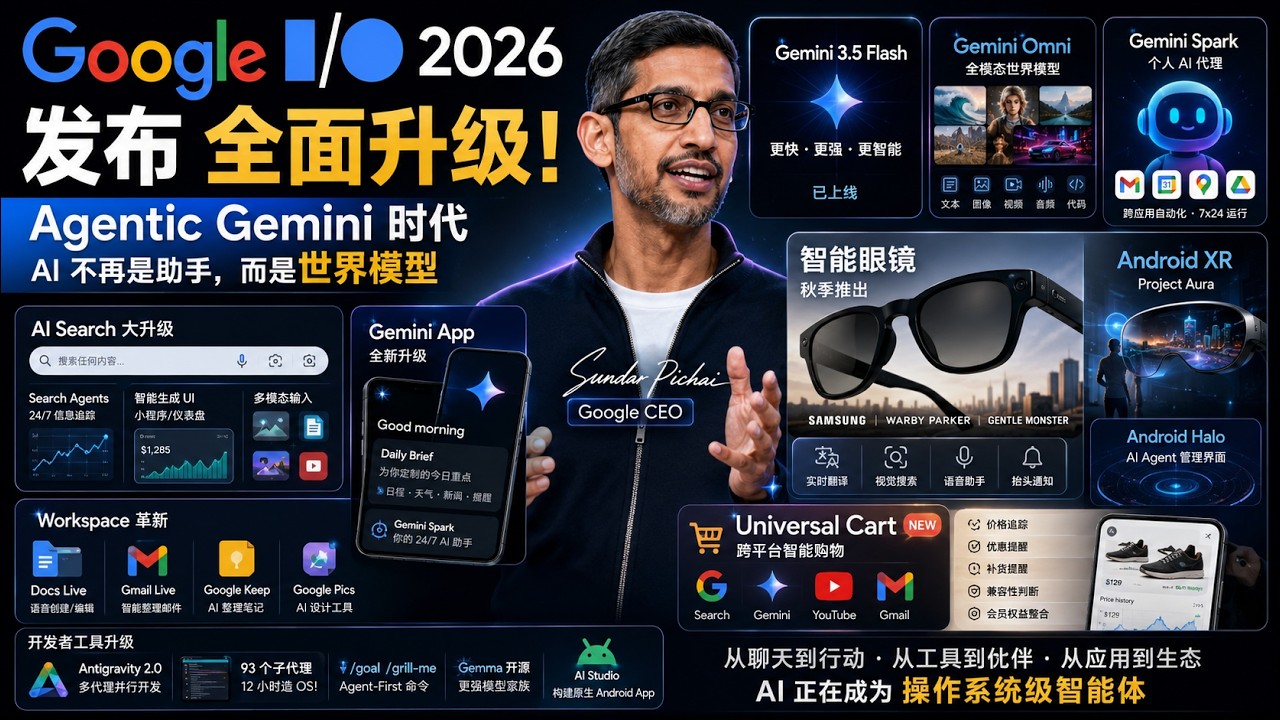
Perhaps the most visually striking announcement at Google I/O 2026 was Gemini Omni, a new model designed to generate output from any input, starting with video. Described by Koray Kavukcuoglu as “where Gemini’s ability to reason meets the ability to create”, Gemini Omni combines Gemini’s intelligence with the best of Google’s generative media models for a new level of world understanding, multimodality, and editing.
The model represents a significant departure from previous approaches to generative AI. Rather than being limited to specific input-output pairs, Gemini Omni can accept any combination of images, audio, video, and text as input and generate high-quality videos that draw upon Gemini’s real-world knowledge. Over time, Google plans to expand Gemini Omni’s capabilities so it can generate any output from any input.
B. Understanding Physics and Real-World Dynamics
What sets Gemini Omni apart from other video generation models is its improved understanding of physics. The model demonstrates a grasp of forces like gravity, kinetic energy, and fluid dynamics, allowing it to create more realistic scenes. This understanding bridges the gap from photorealism to meaningful storytelling, combining an intuitive comprehension of physics with Gemini’s knowledge of history, science, and culture.
The practical implications are substantial. As demonstrated during the keynote, users can edit video using natural language, with every instruction building on the last. Characters remain consistent throughout scenes, physics hold up, and the scene remembers what came before. This level of control and consistency has been a significant challenge in video generation, and Gemini Omni represents a meaningful step forward.
C. Availability and Integration
Gemini Omni Flash is rolling out to all Google AI Plus, Pro, and Ultra subscribers worldwide through the Gemini app and Google Flow. It is also available for free in YouTube Shorts Remix for users aged 18 and older. This broad availability ensures that millions of users can immediately begin experimenting with the technology.
To address concerns about synthetic media, videos created with Gemini Omni include Google’s imperceptible SynthID digital watermark. Users can easily verify content through the Gemini app, providing a layer of transparency and accountability for AI-generated media. This commitment to responsible AI development reflects Google’s awareness of the potential societal impacts of generative AI and its efforts to mitigate misuse.
Part IV: Gemini Spark The 24/7 Personal AI Agent
A. Always-On, Always-Working Intelligence
One of the most significant consumer-facing announcements at I/O 2026 was Gemini Spark, a personal AI agent that runs around the clock. Powered by Gemini 3.5 Flash, Gemini Spark operates in the background using virtual machines on Google Cloud, eliminating the need for users to keep their devices powered on continuously.
Unlike traditional assistants that only respond when asked a question, Gemini Spark is designed to be proactive. It can monitor credit card statements for hidden subscription fees, write emails, create study guides, and perform a wide range of other tasks autonomously. The agent connects to Google Workspace applications including Docs, Gmail, Sheets, and Slides, enabling it to work across the entire productivity ecosystem.
B. Enterprise and Consumer Applications
Gemini Spark is available for both Gemini Enterprise and Google Workspace customers. Under user direction, it can represent them in automatically executing tasks, helping them work more efficiently. The agent can plan multi-step tasks, collaborate across applications, and currently supports Google tools including Gmail, YouTube, with plans to open the Model Context Protocol (MCP) to third-party applications.
For enterprise customers, the implications are significant. Gemini Spark can handle routine but time-consuming tasks such as email management, event planning, and calendar coordination. By delegating these responsibilities to an always-on AI agent, knowledge workers can focus on higher-value activities that require human judgment and creativity.
C. The Evolution of the Gemini App
Gemini Spark represents a major evolution of the Gemini app experience. The app has grown from 400 million monthly active users at I/O 2025 to more than 900 million users in 2026, with daily AI requests increasing more than sevenfold. The app is also receiving a visual refresh called Neural Expressive, featuring new colorful backgrounds, a new typeface, new animations for live voice chats, and expanded accent options in multiple languages.
Another new feature coming to the Gemini app is Daily Brief, an AI agent that provides personalized summaries integrating information from inboxes, calendars, and tasks. This feature helps users stay on top of important matters without manually reviewing multiple sources of information. Combined with Gemini Spark, these capabilities position the Gemini app as the central hub for personal AI assistance.
Part V: Google Antigravity 2.0 The Agent-First Development Platform
A. From IDE to Ecosystem
For developers, one of the most consequential announcements was the expansion of Google Antigravity from a single product into a cohesive ecosystem. Google Antigravity 2.0, launched at I/O 2026, transforms the agentic coding tool into a comprehensive development platform with multiple surfaces: a standalone desktop application, a command-line interface, a software development kit, managed agents within the Gemini API, and an enterprise deployment path through the Gemini Enterprise Agent Platform.
The Antigravity 2.0 desktop application fully delivers an agent-optimized experience. It acts as a central home for agent interaction, allowing developers to orchestrate multiple agents to execute tasks in parallel. Key features include dynamic subagents for parallelized workflows, scheduled tasks for background automation, and ecosystem integrations across Google AI Studio, Android, and Firebase.
B. Antigravity CLI and SDK
For developers who prefer to work in the terminal, the Antigravity CLI delivers a lightweight, high-velocity product surface that lets users create new agents instantly without a graphical user interface. Google is encouraging Gemini CLI users to migrate to Antigravity CLI.
The Antigravity SDK provides programmatic access to the same agent harness powering Google’s products. Optimized for Gemini models, the SDK allows developers to define custom agent behaviors and host them on their infrastructure of choice. This flexibility is crucial for enterprises with specific security, compliance, or integration requirements.
C. Managed Agents and Enterprise Integration
Perhaps most significantly, Google introduced Managed Agents in the Gemini API. With a single API call, developers can now spin up an agent that reasons, uses tools, and executes code in an isolated Linux environment. These managed agents are powered by the Antigravity agent harness and built on Gemini 3.5 Flash, removing the friction of infrastructure setup and delivering the full power of the Antigravity agent harness through a simple API.
For enterprises, Antigravity is now available through the Gemini Enterprise Agent Platform. This simplifies enterprise workloads by allowing Google Cloud customers to connect Antigravity directly to Google Cloud projects. The integration brings agentic development capabilities to entire organizations.
D. Pricing and Accessibility
Google also introduced a new $100/month Google AI Ultra subscription plan. This plan is designed to bring the frontier of intelligence into users’ workflows with a five times higher usage limit in Google Antigravity than the Google AI Pro plan. To encourage adoption, Google is offering new and existing AI Ultra subscribers $100 in bonus credits for Antigravity that activate if users hit their plan’s quota limit.
Part VI: The Search Revolution
A. The Biggest Change in 25 Years
Google called the new search experience introduced at I/O 2026 the biggest upgrade to Search in over 25 years. The traditional search box has been transformed into what the company calls an “intelligent search box”, allowing users to search using text, images, files, videos, and Chrome tabs, with Search reasoning across all of them simultaneously.
The new search experience starts rolling out to everyone immediately. When users ask complex questions, Search responds with more contextual answers and can use generative AI to create images or short video clips that help explain concepts. For example, a search about black holes might generate a video that visually explains the process, placed directly within search results.
B. Generative UI and Dynamic Interfaces
Search is also receiving a Generative UI feature that creates different ways of viewing information from search results. Different types of responses videos, images, news articles receive custom layouts generated in the browser on the fly based on what is most relevant. Generative UI will start appearing in Google searches during the summer of 2026.
Using Gemini 3.5 and Google’s Antigravity platform, Search will soon generate custom layouts, visuals, and even persistent mini dashboards tailored to individual queries. This represents a fundamental rethinking of how search results are presented, moving beyond the traditional list of blue links to dynamic, interactive experiences.
C. AI Overviews and AI Mode
Google is folding AI Overviews and AI Mode into one seamless experience. AI Overviews now reaches more than 2.5 billion monthly users, while AI Mode, powered globally by Gemini 3.5 Flash as its default model, has surpassed 1 billion users. These features demonstrate how AI is fundamentally changing how people interact with Search.
D. Search Agents
The arrival of Search agents represents perhaps the most profound change to the search experience. Google is starting with information agents, which work continuously in the background to help users track topics, monitor information, and take actions automatically. These personalized AI agents can be set up to find and deliver updates without requiring repeated searches.
This shift from query-based searching to continuous, agent-driven information gathering represents a fundamental change in the relationship between users and search technology. Rather than actively seeking information, users can delegate monitoring and tracking to AI agents that work on their behalf.
Part VII: Android’s Transformation into an Intelligent System
A. From Operating System to Intelligence System
Google announced at I/O 2026 that Android is transitioning from an operating system to an intelligence system. This represents a fundamental rethinking of the mobile platform’s role in users’ digital lives. The Android OS now supports agents like Gemini in automatically completing tasks, meaning agents can operate applications on behalf of users.
B. Android CLI and Skills for Developers
For developers, the stable Android CLI enables AI agents to tap directly into the power of Android Studio. It can handle tasks like downloading the Android SDK, running apps on Android devices, and more, allowing developers to create high-quality Android apps using any agent, large language model, and tool of their choice.
Google also open-sourced Android skills to help large language models execute best practices for complex workflows and APIs. This includes migrations to Jetpack Compose and Jetpack Navigation 3. The Android Bench tool provides AI with nuanced understanding of Android development.
C. Android XR and Smart Glasses
Google also previewed its Android XR eyewear at I/O 2026. The company confirmed that audio-based AI glasses designed in partnership with Gentle Monster and Warby Parker will arrive in the autumn of 2026. These glasses have no display but include cameras, AI vision capabilities, and multimodal input capabilities. They run on the Android XR operating system and support both Android and iOS devices.
The glasses are designed to pair with phones and use the Android XR platform developed jointly by Google, Samsung, and Qualcomm. While Google also teased display models, no timeline was provided for their release. This cautious approach reflects Google’s measured strategy in the augmented reality space.
Part VIII: Workspace Intelligence and Productivity
A. Docs Live
Google introduced Docs Live at I/O 2026, a feature that allows users to converse with Google Docs using voice rather than typing specific prompts. In a demonstration, a user preparing for a high school career day had Gemini automatically extract speech points, retrieve resume information from Google Drive, and help create and edit documents.
Docs Live is designed to turn spoken thoughts into structured documents. The feature can organize ideas, generate outlines, and pull relevant information from Gmail, Drive, Chat, and the web with user permission. This represents a significant step toward more natural, conversational interactions with productivity software.
B. Ask YouTube and Other Workspace Features
Google also announced Ask YouTube, a conversational search interface for the video platform. This feature allows users to ask questions and receive answers based on YouTube’s vast content library, making the platform more interactive and useful for learning and discovery.
Additional Workspace features include new image generation and editing tools called Google Pics, as well as new voice capabilities in Gmail, Google Docs, and Keep. These features are designed to reshape how users work, making AI an integral part of the productivity experience.
Part IX: Scientific Research and AI
A. AI for Scientific Discovery
Google also announced AI-based tools designed to accelerate progress for the global scientific community. These include Empirical Research Assistance (ERA) and Co-Scientist, both published in Nature in the week leading up to I/O. These tools demonstrate Google’s commitment to using AI to advance scientific discovery and address complex research challenges.
B. Quantum-AI Future
Google also previewed work on building the quantum-AI future. While still in early stages, the intersection of quantum computing and artificial intelligence represents a long-term research direction with potentially transformative implications.
Part X: The Industry Impact and Competitive Landscape
A. The Agentic Shift Across the Industry
Google I/O 2026 made it clear that the entire technology industry is shifting toward agentic AI. As one analysis noted. The company’s vertical integration strategy from custom silicon to consumer applications positions it uniquely to capitalize on this shift.
Google’s aggressive push into agents represents a direct challenge to competitors including OpenAI, Microsoft, Anthropic, and Meta. The company’s massive scale 900 million Gemini users, 2.5 billion AI Overviews users, and 8.5 million developers building on Gemini models gives it significant advantages in data, distribution, and ecosystem integration.
B. Implications for Developers
For developers, the message from I/O 2026 was clear: the future is agentic, and Google is providing the tools to build that future. The Antigravity 2.0 ecosystem, Managed Agents in the Gemini API, and Android CLI all point toward a development paradigm where AI agents are not just tools but collaborators in the development process.
The ability to spin up agents with a single API call, orchestrate multiple agents in parallel, and build Android apps using natural language represents a fundamental shift in how software will be developed. Developers who embrace these tools will be able to build more sophisticated applications faster and with less effort than ever before.
C. Implications for Enterprises
For enterprises, Google I/O 2026 signaled the arrival of the “Agentic Enterprise”. The Gemini Enterprise Agent Platform, Agentic Data Cloud, and Workspace Intelligence provide the foundational building blocks for organizations to deploy AI agents at scale.
CodeMender, a security agent that helps find and fix vulnerabilities in code, demonstrates the practical value of agentic AI for enterprise security. The ability to deploy managed agents in secure, Google-hosted environments addresses enterprise concerns about security and compliance.
Conclusion
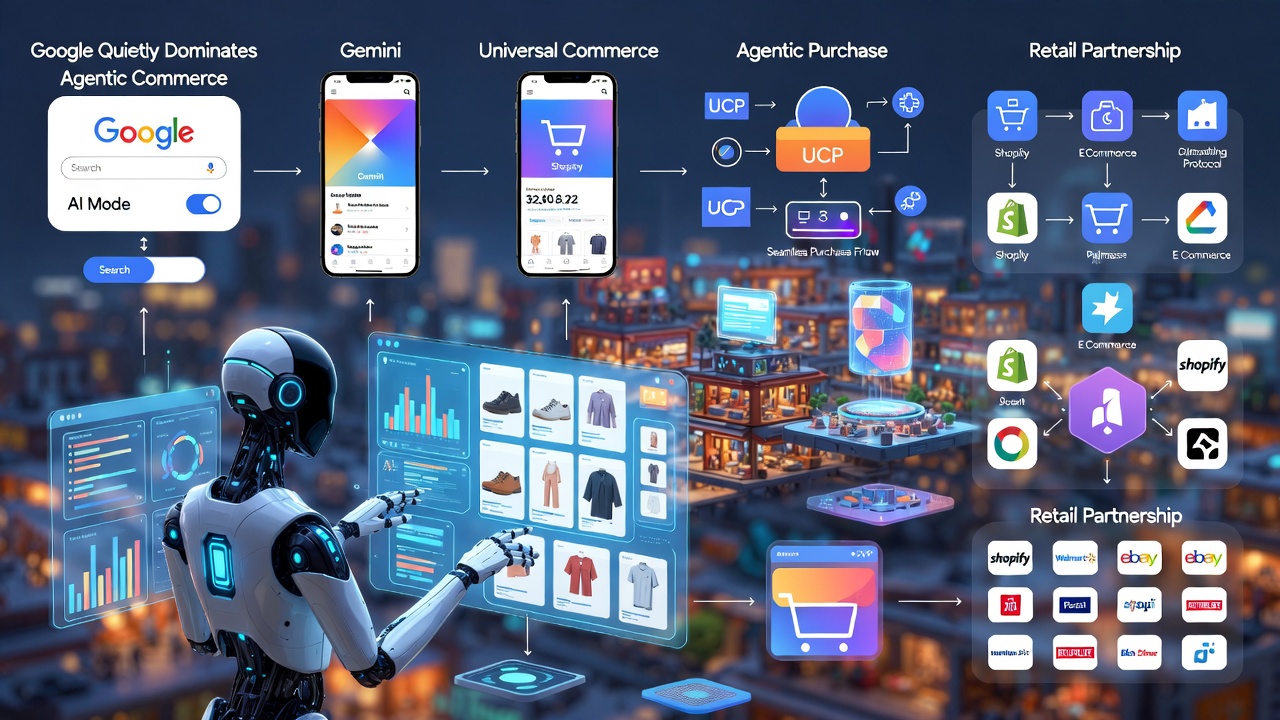
Google I/O 2026 represented a watershed moment in the evolution of artificial intelligence. The company’s declaration of the “Agentic Gemini Era” signaled a fundamental shift in how AI would interact with users moving from passive chatbots that merely respond to questions to proactive digital agents capable of autonomous action across the entire digital ecosystem.
The announcements at I/O 2026 collectively paint a picture of a company that is fully committed to agentic AI across every layer of its technology stack. From the custom TPU 8t and TPU 8i chips powering the underlying infrastructure to the Gemini 3.5 Flash model driving agentic workflows, from the Gemini Omni model enabling creation from any input to the Gemini Spark personal agent working 24/7 on users’ behalf, from the Antigravity 2.0 development platform empowering developers to the intelligent search box transforming how people find information Google is building a comprehensive ecosystem for agentic AI.
The numbers tell the story of massive scale and accelerating adoption: 3.2 quadrillion tokens processed monthly, 19 billion tokens per minute through model APIs, 900 million Gemini users, 2.5 billion AI Overviews users, and 8.5 million developers building on Gemini models. These numbers reflect not just Google’s ambition but the genuine demand for AI-powered products and services.
As Sundar Pichai noted during his keynote, “Ten years since we pivoted the company to be AI-first, we still see AI as the most profound way to advance our mission and improve people’s lives at scale”. With the announcements at I/O 2026, Google has made it clear that the next decade of AI will be defined not by what AI can answer, but by what AI can do.
The transition from prompts to action, from assistance to agency, represents the next frontier in artificial intelligence. Google I/O 2026 provided a roadmap for that frontier, and the destination is a world where AI agents work alongside humans as active partners in achieving goals, solving problems, and creating value. The agentic era has begun, and its implications for technology, business, and society will unfold in the years to come.