
In a move that has sent shockwaves through both the aerospace and artificial intelligence industries, SpaceX has fundamentally transformed its business identity. What began as a rocket launch company and satellite internet provider has rapidly evolved into one of the most consequential players in the global AI infrastructure race. Through a series of landmark agreements, strategic acquisitions, and ambitious long-term planning, Elon Musk’s space venture is positioning itself at the intersection of compute power, energy, and orbital technology a combination that could redefine how artificial intelligence is built and deployed for decades to come.
The transformation is not merely a corporate pivot; it represents a fundamental rethinking of where and how AI infrastructure should exist. As terrestrial data centers face mounting constraints around power availability, land use, and environmental impact, SpaceX is betting that the ultimate answer lies beyond Earth’s atmosphere. This article examines the major AI deals SpaceX has signed, the strategic logic behind its merger with xAI, the financial implications for its upcoming IPO, and the bold vision of orbital data centers that could reshape the entire AI landscape.
The Anthropic Compute Agreement
One of the most significant developments in SpaceX’s AI expansion came in May 2026, when the company entered into a Cloud Services Agreement with Anthropic PBC, the artificial intelligence research and development public benefit corporation behind the Claude family of AI models. The agreement, disclosed in SpaceX’s regulatory filings, grants Anthropic access to compute capacity across SpaceX’s COLOSSUS and COLOSSUS II data center facilities.
Under the terms of the deal, Anthropic agreed to pay SpaceX $1.25 billion per month through May 2029, with capacity ramping up during May and June 2026 at a reduced introductory fee. The compute infrastructure provided to Anthropic includes approximately 325,000 NVIDIA GPUs, backed by hyperscale-class CPUs, exabyte-scale storage, and high-speed networking and interconnects purpose-built for AI workloads. The COLOSSUS 1 data center alone is reported to contain more than 220,000 NVIDIA chips and approximately 300 megawatts of capacity.
What makes this arrangement particularly notable is its flexible termination clause. After an initial three-month period, either party may terminate the agreement upon 90 days’ notice. Elon Musk has characterized the lease as a short-term contract, explaining that SpaceX wanted to retain the option of reclaiming the computing capacity for its own internal AI initiatives particularly the training of future Grok models, which are being developed at COLOSSUS II. This dual-monetization strategy allows SpaceX to generate substantial revenue from third-party customers while preserving the flexibility to scale its proprietary AI applications as needed.
The Anthropic deal alone is projected to generate well over $40 billion in revenue for SpaceX over the life of the contract, making it one of the largest AI infrastructure agreements ever signed by a private technology company.
The Google Computing Contract
Following closely on the heels of the Anthropic agreement, SpaceX secured a second massive computing contract with Google. According to reports, Google is expected to pay SpaceX approximately $920 million per month from October 2026 through June 2029 for access to computing resources. This arrangement reportedly includes around 110,000 NVIDIA GPUs and related infrastructure designed to support demand for Google’s AI products, including Gemini Enterprise.
When combined, the Anthropic and Google agreements represent a staggering financial commitment. The combined value of these computing-access deals could exceed $70 billion if the contracts are carried out in full, with an estimated annual value of approximately $26 billion together. For a company that has traditionally been valued primarily for its launch services and Starlink satellite internet business, these AI compute contracts represent an entirely new and highly lucrative revenue stream.
The timing of these agreements is strategically significant. SpaceX is preparing for a highly anticipated initial public offering, and steady income from AI compute leasing could substantially strengthen its appeal to investors. Reports suggest the company may aim to raise as much as $75 billion through its US stock market debut—a figure that would make it one of the largest IPOs in history.
The xAI Merger: Vertical Integration
The foundation for SpaceX’s AI ambitions was laid in February 2026, when the company announced the acquisition of xAI, Musk’s artificial intelligence startup, in an all-stock transaction valued at approximately $250 billion. The merger created a combined entity valued at approximately $1.25 trillion, making it one of the most valuable private companies in history.
The strategic rationale behind the merger was straightforward: Musk believes that advanced AI systems require enormous amounts of computing power and energy, and that these demands are rapidly approaching the practical limits of traditional ground-based data centers. In his announcement, Musk stated that space-based AI represents the only viable path to scaling.
The merger brought together several complementary assets under one corporate umbrella:
-
Rocket launch capability through SpaceX’s Falcon and Starship programs
-
Global satellite communications through the Starlink constellation
-
AI model development through xAI’s Grok chatbot
-
Existing data center infrastructure including the COLOSSUS supercomputer clusters
-
Social media data and distribution through the X platform
By integrating these capabilities, SpaceX aims to create a vertically integrated innovation engine that spans from energy and transportation to computation and artificial intelligence.
Following the merger, xAI’s independent corporate structure was dissolved and integrated into SpaceX’s internal AI division, rebranded as SpaceXAI. The new division is responsible for developing frontier AI models, managing the Colossus supercomputer infrastructure, and executing the company’s long-term vision of deploying AI compute capacity in orbit.
The Cursor Acquisition and AI Model Development
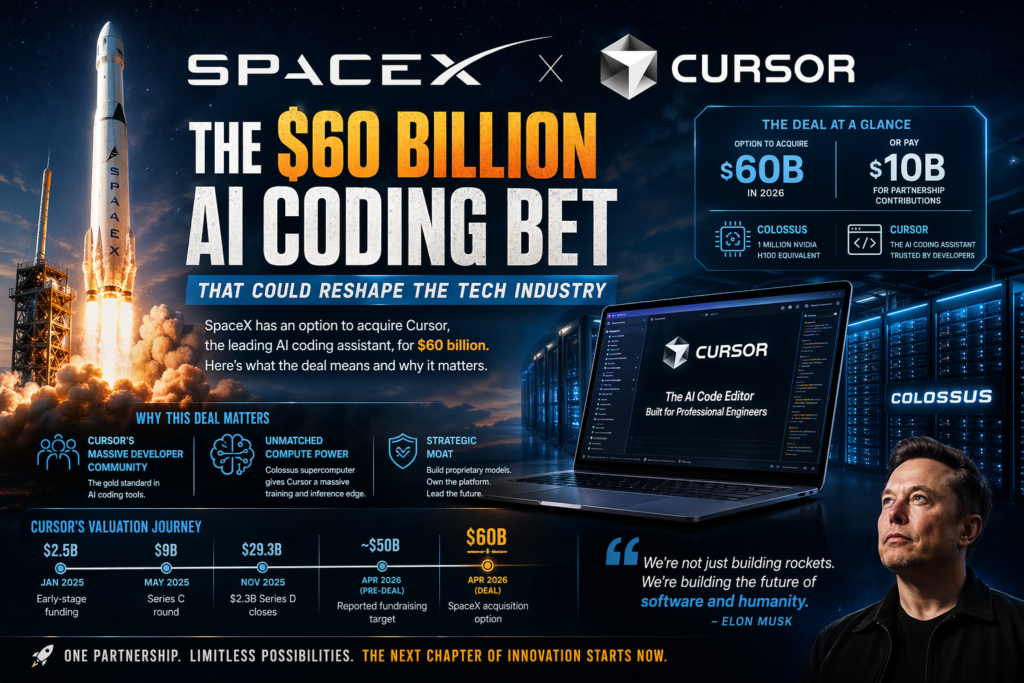
SpaceX’s AI ambitions extend beyond infrastructure into model development. In June 2026, the company announced a $60 billion all-stock acquisition of Anysphere, the startup behind the AI code editing platform Cursor. The deal, announced shortly after SpaceX’s IPO filing, is designed to help the company build what it described as “the world’s most useful AI models”.
The acquisition followed an earlier partnership between SpaceXAI and Cursor, during which the two companies jointly trained a model that was subsequently released in both Cursor and Grok Build. Cursor’s team had previously expressed that their model training efforts were bottlenecked by compute availability, and the partnership with SpaceX provided access to the Colossus infrastructure needed to dramatically scale up their AI capabilities.
This acquisition reflects a broader strategy by SpaceX to control the entire AI value chain from the physical infrastructure of GPUs and data centers to the frontier models that run on them. By owning both the compute layer and the model layer, SpaceX positions itself to capture value at multiple points in the AI economy.
The Vision of Orbital Data Centers
The most ambitious element of SpaceX’s AI strategy is its plan to deploy data centers in space. Musk has articulated a vision in which orbital data centers, powered by near-unlimited solar energy and cooled by the natural low temperatures of space, will ultimately provide the lowest-cost AI computing capacity available.
The logic behind this vision rests on several key observations:
A. Terrestrial data centers face escalating constraints related to electricity availability, land acquisition, and environmental regulations. The power requirements for training and operating frontier AI models are growing exponentially, and electrical grid infrastructure is struggling to keep pace.
B. Space-based solar power is significantly more efficient than ground-based solar, as there is no atmospheric interference, no weather, and no day-night cycle. Satellites in low Earth orbit can receive continuous sunlight, enabling constant power generation.
C. The vacuum of space provides an ideal environment for heat dissipation. While traditional data centers require massive cooling systems that consume significant energy and water, space-based facilities can radiate waste heat directly into the void.
D. SpaceX’s reusable rocket technology, particularly the Starship vehicle, is designed to dramatically reduce the cost of launching mass into orbit. Musk has estimated that if SpaceX can launch approximately one million tons of satellites per year, with each ton capable of generating around 100 kilowatts of computing power, the company could add approximately 100 gigawatts of AI compute capacity annually.
SpaceX has already filed applications with the Federal Communications Commission to deploy a system of up to one million satellites in low Earth orbit, operating at altitudes between 500 and 2,000 kilometers. These satellites would be powered by solar energy, communicate with each other and with the Starlink network via laser links, and function as a distributed orbital data center network.
Musk has stated that within two to three years, space is likely to become the lowest-cost location for AI computing. He has framed this ambition in the context of the Kardashev scale, describing the deployment of orbital data centers as the first step toward a Type II civilization capable of harnessing the full energy output of the Sun.
Financial Implications and IPO Considerations
The financial scale of SpaceX’s AI investments is staggering. In the second quarter of 2026 alone, SpaceX’s capital expenditures surged more than sixfold year over year, from $2.83 billion to $18.37 billion. Of that total, $15.8 billion—approximately 86 percent—was allocated to expanding the company’s AI business.
The company’s first-quarter capital expenditures had already reached $10.1 billion, with nearly 80 percent directed toward AI-related investments. xAI, the AI division, reported a loss of $2.4 billion during the first three months of 2026, compared to $936 million a year earlier, reflecting the massive upfront investments required to build out data center infrastructure.
Despite these substantial expenditures, SpaceX’s overall financial performance has remained strong. In the second quarter of 2026, the company’s revenue surged 92 percent year over year to $7.8 billion, and it narrowed its net loss from $1.01 billion to $541 million. The AI compute leasing agreements with Anthropic and Google provide a predictable, high-margin revenue stream that helps offset the capital-intensive nature of AI infrastructure development.
For investors considering the upcoming IPO, the AI compute contracts serve as a compelling proof point that SpaceX can monetize its infrastructure investments. The company’s ability to generate approximately $26 billion annually from just two customers demonstrates the enormous demand for GPU capacity among leading AI companies. SpaceX has indicated that it expects to enter into additional similar services contracts with third parties, further expanding this revenue stream.
Market Impact and Competitive Dynamics
SpaceX’s entry into the AI infrastructure market has significant implications for the broader technology landscape. The company is effectively positioning itself as a competitor to major cloud providers like Amazon Web Services, Microsoft Azure, and Google Cloud, but with a differentiated offering focused specifically on high-performance AI compute.
The competitive dynamics are complex. Google, one of SpaceX’s compute customers, is also a competitor in the AI model space through its Gemini products. Anthropic, another customer, develops the Claude models that compete with SpaceX’s Grok. This creates a situation where SpaceX is simultaneously selling infrastructure to competitors while developing its own competing AI models a dynamic that mirrors the complex relationships between semiconductor manufacturers and their customers.
Analysts have noted that the presence of termination clauses in the compute agreements could influence how investors assess their long-term value. The Anthropic deal, in particular, can be terminated by either party with 90 days’ notice after the initial three-month period, giving SpaceX flexibility but also introducing revenue uncertainty.
The deals also highlight the intense competition for computing capacity among leading AI companies. Anthropic, Google, OpenAI, and other major firms are investing heavily in infrastructure as they race to train and operate increasingly powerful AI systems. SpaceX’s ability to provide large-scale GPU capacity positions it as a critical supplier in this ecosystem.
The Pentagon and Government Contracts
Beyond commercial agreements, SpaceX is also pursuing government contracts for AI computing services. Reports indicate that the company is in negotiations with the US Department of Defense for multi-billion-dollar AI computing supply agreements. The Pentagon already makes extensive use of SpaceX’s launch vehicles, Starlink satellite communications, and military satellite services.
Additionally, the Space Development Agency awarded SpaceX a $1.8 billion contract in March 2026 for military AI inference capacity on its Starweave platform, with use cases including intelligence analysis, battlefield situational awareness, and autonomous systems support.
These government contracts add another layer of revenue diversification and strategic importance to SpaceX’s AI infrastructure business. They also raise important questions about the concentration of critical AI infrastructure in a single private company and the implications for national security and technological sovereignty.
Challenges and Risks
While SpaceX’s AI ambitions are bold, they are not without significant challenges. The technological hurdles associated with deploying and maintaining data centers in orbit are substantial. Satellites must withstand the harsh conditions of space, including radiation, micrometeorite impacts, and extreme temperature fluctuations. Repairing or upgrading orbital infrastructure is far more difficult and expensive than maintaining terrestrial facilities.
The economics of orbital data centers also remain unproven. While Musk has argued that space-based solar power and natural cooling will ultimately make orbital computing cheaper than ground-based alternatives, this hypothesis has yet to be validated at scale. The initial capital costs of launching and deploying a million-satellite constellation would be astronomical, even with reusable rocket technology.
Regulatory challenges also loom large. The deployment of one million satellites in low Earth orbit raises serious concerns about space debris, orbital congestion, and interference with astronomical observations. SpaceX will need to navigate a complex web of international regulations and negotiate with governments around the world to secure the necessary approvals.
Finally, the integration of xAI into SpaceX has raised concerns among some investors about the potential dilution of value from the profitable launch and Starlink businesses. The merger involved the issuance of $250 billion in new SpaceX shares, which diluted existing shareholders and added a loss-making entity to the company’s financial statements.
Conclusion

SpaceX’s transformation from a rocket launch company into an AI infrastructure powerhouse represents one of the most significant corporate pivots in modern business history. Through landmark compute agreements with Anthropic and Google, the strategic acquisition of xAI, and the ambitious vision of orbital data centers, Elon Musk is attempting to build a vertically integrated AI empire that spans from energy generation to frontier model development.
The financial stakes are enormous. The combined value of SpaceX’s AI compute contracts could exceed $70 billion, providing a massive new revenue stream as the company prepares for what may be the largest IPO in history. The company’s capital expenditures on AI infrastructure have already reached unprecedented levels, reflecting a deep conviction that computing power will be the defining resource of the coming decades.
Whether the orbital data center vision becomes reality remains to be seen. The technological, economic, and regulatory challenges are formidable. But if SpaceX succeeds, it could fundamentally reshape not only the AI industry but also the broader relationship between humanity and space. The company’s bet on AI infrastructure is, at its core, a bet on the future and few companies are as well-positioned to place such a wager.
As the AI race intensifies and demand for compute capacity continues to soar, SpaceX’s unique combination of launch capability, satellite infrastructure, and AI expertise gives it a competitive advantage that few if any rivals can match. The coming years will determine whether this bold strategy delivers on its extraordinary promise.