The concept of communicating with machines using only the power of thought has long been a cornerstone of science fiction. Today, this futuristic vision is steadily becoming a scientific reality, driven by the intense race to develop Brain-Computer Interfaces (BCIs). While Elon Musk’s Neuralink has captured headlines with its invasive, chip-based approach, Meta, the parent company of Facebook, is pursuing a dramatically different and potentially more accessible path. Under the leadership of CEO Mark Zuckerberg, Meta is making significant strides in developing non-invasive brain-reading technology. This comprehensive article delves into Meta’s ambitious project, exploring its technological foundations, remarkable achievements, inherent limitations, and the profound ethical questions it raises about the future of human-computer interaction and data privacy.
The Genesis of a Thought-Controlled Future
Meta’s journey into the realm of brain-computer interfaces is not a sudden pivot but a continuation of a vision that CEO Mark Zuckerberg articulated years ago. In 2017, the company (then known as Facebook) expressed its ambition to develop a system that would allow users to type directly from their brains. The initial concept was a consumer-friendly “brain-reading hat” that would translate thoughts into text. However, as with many grand technological endeavors, the path from concept to reality proved far more challenging than anticipated. The company’s early consumer-focused hardware efforts were eventually shelved due to technical obstacles.
Despite these setbacks, Meta never abandoned its core research. Instead, the focus shifted from creating an immediate consumer product to a deeper, more fundamental investigation into the nature of human intelligence. Jean-Rémi King, the leader of Meta’s “Brain & AI” research team, emphasizes that the primary goal is not a marketable device but to unravel the computational principles of the brain to inform the development of more powerful Artificial Intelligence. This strategic shift underscores the company’s belief that understanding the biological foundation of intelligence is key to building truly intelligent machines. “Trying to understand the precise architecture or principles of the human brain could be a way to inform the development of machine intelligence,” King stated.
The Technology Behind the Thought: Brain2Qwerty
Meta’s breakthrough system is called Brain2Qwerty, a name that cleverly references the standard QWERTY keyboard layout, indicating its function of translating brain activity associated with typing into text. The technology works by interpreting the brain’s signals as a person types. Crucially, the latest version, Brain2Qwerty v2, represents a significant evolution from the initial proof of concept.
A Non-Invasive Approach: The MEG Helmet
The most defining feature of Meta’s BCI is its non-invasive nature. Unlike Neuralink, which requires surgical implantation of electrodes into brain tissue to read neural signals, Meta’s system uses a wearable device to capture brain activity from outside the skull. This is a critical distinction, as it eliminates the risks associated with brain surgery, such as infection, inflammation, and long-term health complications. The goal is to create a technology that is safer, more scalable, and more ethically palatable.
To accomplish this, the system primarily relies on a technology called magnetoencephalography (MEG). MEG is a neuroimaging technique that measures the minuscule magnetic fields generated by the electrical currents of active neurons in the brain. These magnetic signals are incredibly faint several orders of magnitude weaker than the Earth’s own magnetic field but they can be detected by the highly sensitive sensors housed within a specialized helmet. While participants in the study are required to wear this sensor-laden helmet, it is important to note that this is not a stylish cap for everyday use. It is a large, complex piece of equipment currently requiring a controlled, shielded environment.
How It Works: From Thought to Text
The process of decoding thoughts into text is a sophisticated interplay of neuroscience and artificial intelligence. Here’s a step-by-step breakdown of how the system operates:
A. The Typing Task and Data Collection:
In a controlled laboratory setting, volunteers are asked to type phrases, often in Spanish, on a keyboard while their brain activity is recorded. For the training of Brain2Qwerty v2, nine participants spent approximately 10 hours each wearing the MEG device, collectively typing around 22,000 sentences. This generated a massive dataset of brain signals correlated with specific keystrokes.
B. Capturing Brain Signals with MEG:
The MEG device measures the magnetic fields produced by the brain’s neural activity. While MEG is more expensive and less portable than EEG (electroencephalography), which measures electrical activity, Meta found it to be far superior in terms of accuracy. In their research, the MEG system achieved a character error rate of 29%, compared to a 65% error rate for EEG. This higher signal-to-noise ratio is crucial for the deep learning algorithms to work effectively.
C. Decoding with Deep Learning:
The collected raw brain signals are then processed by a deep-learning system, Brain2Qwerty. Unlike earlier versions that relied on hand-engineered pipelines to detect specific neural events, the v2 system uses an end-to-end deep learning approach. This means the AI is trained on the raw, unfiltered data, allowing it to discover its own complex patterns to decode language directly from the brain signals.
D. Fine-Tuning with Large Language Models:
The final step involves fine-tuning Large Language Models (LLMs) on the neural data. The LLMs act like a powerful, semantic autocorrect. Because the brain signals can be noisy or ambiguous, the LLM uses its understanding of context and grammar to predict the most likely intended sentence, bridging the gap between imperfect neural recordings and coherent language.
Measuring Success: Accuracy and Improvement
The performance of any BCI is measured by its accuracy, and the improvements made from Brain2Qwerty v1 to v2 are noteworthy.
| Metric | Brain2Qwerty v1 (2025) | Brain2Qwerty v2 (2026) |
|---|---|---|
| Approach | Hand-engineered pipeline | End-to-end deep learning |
| Key Accuracy | Up to 80% character accuracy | 61% word accuracy (avg.), 78% for best participant |
| Comparison | N/A | 8x improvement over prior non-invasive methods |
| Training Data | Not specified | ~22,000 sentences from 9 participants |
While the first version was lauded for achieving up to 80% accuracy at determining individual letters, the second version represents a leap in overall comprehension, achieving an average word accuracy of 61%. For the best-performing participant, this accuracy reached 78%, with more than half of the decoded sentences containing one error or less. This is a substantial improvement over previous non-invasive systems, which typically achieved only single-digit word accuracy. The results were published in the prestigious journal Nature Neuroscience, lending significant credibility to the research.
Meta’s researchers also discovered that the system’s accuracy improves log-linearly with the amount of training data. This suggests that by feeding the AI more data, the performance gap between non-invasive and invasive (surgical) BCIs could be narrowed further.
The Elephant in the Lab: Current Limitations
Despite the impressive results, Meta’s brain-typing system is far from a practical, everyday tool. It faces several profound limitations that currently confine it to the laboratory.
1. Size, Cost, and Infrastructure
The MEG scanner required for the system is not a portable device. It has been described by experts as a massive machine, akin to “an MRI machine tipped on its side and suspended above the user’s head”. The device costs approximately $2 million and is largely immobile. In addition, the scanner can only be operated in a shielded room. The magnetic field of the Earth is a trillion times stronger than the brain’s magnetic signals, and even the slightest interference can corrupt the data.
2. Sensitivity to Movement
The MEG device is also extremely sensitive to movement. The signal is lost the moment a subject moves their head, making it utterly impractical for use in the real world where even small motions are unavoidable.
3. The “Typing” Problem
A more fundamental flaw is that the system is trained to decode the brain signals associated with physical typing. The current technology requires MEG segments to be aligned to specific keystroke onsets, meaning the AI needs to know when a key is physically pressed to correlate it with the brain signal. This makes it useless for its primary stated goal: helping individuals who are “locked-in” or paralyzed and unable to move their fingers. The researchers admit that bridging this gap to help these individuals “will likely involve adapting our task into a motor imagery paradigm” (decoding the thought of moving without the actual movement).
4. Not Real-Time
The current system does not operate in real-time. It requires a trial to conclude before it can process and produce the decoded text. There is no feedback loop for the user, as there is no output until after a participant has finished typing a sentence.
5. The Elephant in the Room: Privacy and Ethics
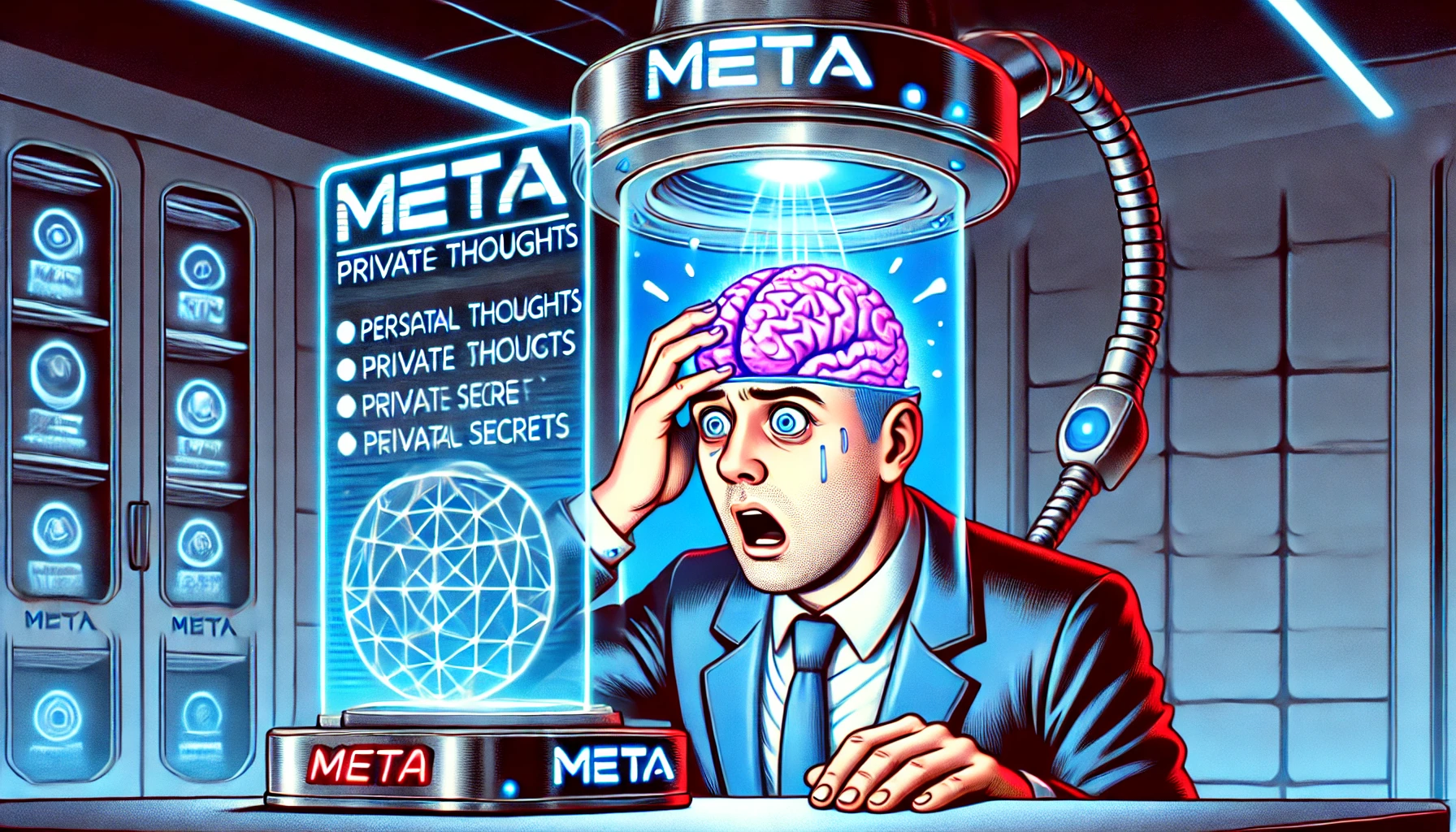
Perhaps the most significant limitation is not technological but ethical. The ability of a company like Meta to read thoughts, even in a limited way, raises profound privacy and ethical dilemmas. Meta’s history of data scandals—from the Cambridge Analytica debacle to its widespread data-sharing practices—has led to deep-seated public distrust. The prospect of a company with such a track record being the gatekeeper for thought-decoding technology is alarming to many.
A. Data Privacy and Ownership: If technology can decode our inner thoughts, who owns that data? What happens if a company sells or is compelled to share this neural data? The concept of “mental privacy” would need to be legally and ethically defined and defended.
B. Potential for Manipulation and Control: The technology could be used for unprecedented surveillance or manipulation. Imagine a workplace where employees’ reactions are monitored in real time, or a social media feed that adapts to not just your clicks, but your brain’s response to content.
C. Mental Health and the “Inner Voice”: Thoughts are not always rational or intended to be shared. An AI that misinterprets a fleeting or intrusive thought could cause confusion, stress, or embarrassment. The fear of having one’s every idea analyzed could lead to self-censorship and anxiety.
D. Corporate Espionage and Security: If a brain-reading device is compromised, it represents the ultimate security breach, exposing a person’s most private thoughts and knowledge.
Meta’s AI and Neuroscience Ecosystem
Meta’s efforts with Brain2Qwerty are part of a larger, coordinated initiative to map and understand the brain. They have launched a broader “Digital Brain Project,” which includes several key components:
| Project/Model | Description |
|---|---|
| Brain2Qwerty v1 & v2 | The core brain-typing AI systems for decoding neural signals into text. |
| TribeV2 | A model for perception encoding, aimed at understanding how the brain processes visual and auditory information. |
| NeuralSet | A framework for processing brain data at scale, enabling the handling of massive neural datasets. |
| NeuralBench | A platform for systematically evaluating brain models, ensuring that AI models are robust and reliable. |
| $5 Million Fund | A fund to support the creation of open neuroscience datasets, encouraging global collaboration and accelerating research. |
By releasing the full training code for Brain2Qwerty and its related datasets, Meta is positioning itself as a key contributor to the open-science community, which is vital for accelerating progress and standardizing research.
Comparison with Invasive BCIs
To fully appreciate Meta’s achievement, it is important to compare it with the invasive approach championed by companies like Neuralink. Invasive BCIs involve surgically implanting electrodes directly into the brain to record neural activity. This provides a much clearer and more detailed signal, allowing for extremely high accuracy. For example, some recent invasive BCI systems have reached up to 92% sentence-level accuracy.
In 2023, a person who lost her voice from ALS was able to speak via a brain-reading software connected to a voice synthesizer, highlighting the life-changing potential of such implants.
However, the trade-offs are significant. Invasive BCIs require risky brain surgery, carry the potential for infection and rejection, and are not easily scalable. Non-invasive systems like Meta’s aim to democratize the technology by eliminating these risks, even if it means sacrificing some immediate accuracy. The future may see a mix of both, with invasive BCIs for severe medical conditions and non-invasive systems for broader consumer and research applications.
The Future of Meta’s Brain Research
While Meta is clear that there is no immediate path to a commercial product based on this specific research, the implications for the company’s core business—AI—are immense. By decoding how the brain processes language, Meta hopes to unlock new principles that can inform the development of more powerful machine intelligence. Language is already the foundation of many modern AI systems, and understanding its biological basis is seen as a key to creating more advanced, human-like thinking machines.
There are also emerging clues that Meta is thinking beyond just language. Alexandr Wang, Meta’s chief AI officer, has revealed that the company is working on “foundation models for brain predictions,” which could potentially predict how a person’s brain will react to content like videos, images, and audio. This could represent a future where AI not only decodes your thoughts but also anticipates your emotional reactions, further blurring the lines between human cognition and machine intelligence.
Conclusion

Meta’s development of Brain2Qwerty represents a monumental scientific achievement in the field of neuroscience and AI. It demonstrates that reading and decoding thoughts from outside the human skull is not just possible, but that its accuracy is rapidly improving. The technology is a powerful tool for understanding the fundamental principles of human intelligence and language. However, it is equally clear that we are still far from a future where we casually don a helmet to communicate telepathically. The current system is a massive, expensive, lab-bound experiment with severe limitations, most notably its need to be combined with the physical act of typing.
Yet, the rapid progress from version 1 to version 2 suggests that many of these barriers are surmountable, even if it takes years or decades. As this technology continues to evolve, the greatest challenges will likely shift from the technical to the ethical. The question is no longer just “Can we read thoughts?” but “How should we use that power, and who can we trust with it?” For a company like Meta, with a complex history regarding user data, navigating the deep well of public skepticism will be just as critical as perfecting the technology itself. The future of thought, it seems, is being written not just by our neurons, but by our society’s laws, ethics, and values.