
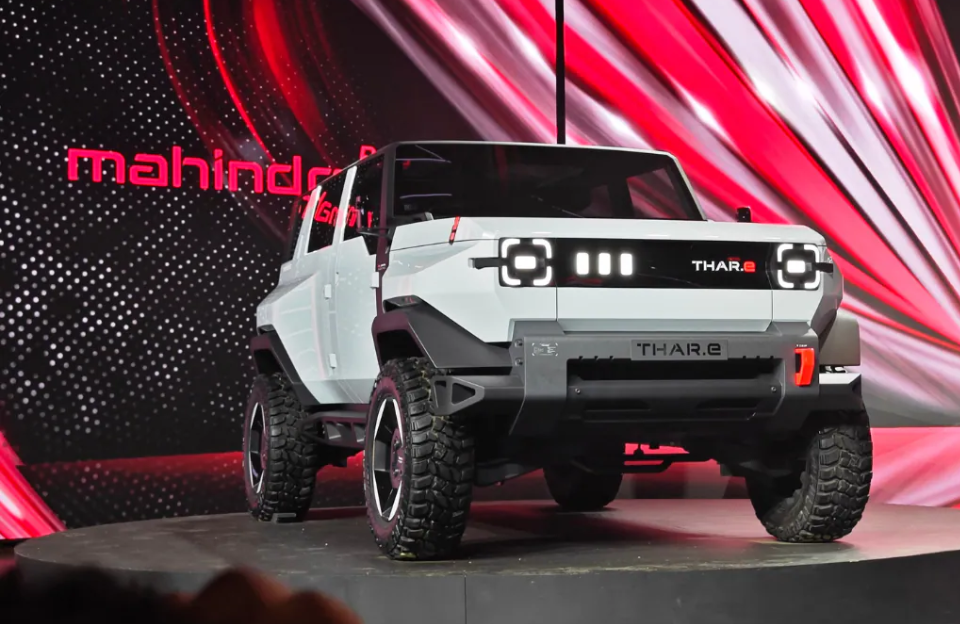
Artificial intelligence continues to reshape how we interact with the world around us, and a recent viral sensation has captured the imagination of internet users while highlighting a growing trend in smart traffic surveillance. The AI-powered “Thar Detector” has taken social media by storm, demonstrating how computer vision technology can be applied to everyday challenges in uniquely entertaining ways . This article explores the phenomenon, technology behind it, and its broader implications for road safety and traffic enforcement.
Understanding the AI Thar Detector Phenomenon
The viral video shows a remarkable demonstration of artificial intelligence in action: a laptop connected to a camera system scanning vehicles on the road, with the screen flashing “THAR DETECTED” when a Mahindra Thar SUV enters its field of view . This seemingly simple application of AI technology has sparked widespread discussion about how artificial intelligence can address common traffic frustrations, particularly in India’s notoriously congested urban environments.
Why the Mahindra Thar Became the Focus
The Mahindra Thar has evolved from a traditional off-road vehicle into a popular lifestyle SUV, particularly among urban buyers seeking adventure and road presence . Its rugged design, elevated driving position, and distinctive appearance have made it one of India’s most recognizable automobiles. However, this popularity has also made it a frequent subject of online memes and discussions, with complaints often focusing on aggressive driving behavior, excessive use of high beams, and unsafe overtaking .
The viral AI detector capitalized on this cultural phenomenon, transforming a common complaint into an engaging demonstration of artificial intelligence capabilities. Social media users quickly embraced the concept, sharing jokes and personal experiences about encounters with aggressive SUV drivers. One user commented, “It’s not the car, it’s how some people drive it” , reflecting a nuanced understanding that the criticism targets driver behavior rather than the vehicle itself.
How the AI Detection Technology Works
Behind this viral demonstration lies sophisticated artificial intelligence technology. The system reportedly uses YOLO (You Only Look Once), a popular computer vision model for real-time object detection . Unlike traditional surveillance systems that require expensive, specialized equipment, this setup appears to use a standard camera feed connected to a laptop running AI software .
The YOLO algorithm has become increasingly sophisticated over recent years. Modern implementations such as YOLOv8, YOLOv11, and other variants offer significant improvements in detection accuracy and speed compared to earlier generations . These models can identify and classify objects in real-time, making them ideal for applications ranging from autonomous driving to traffic surveillance.
The AI system was trained to recognize Mahindra Thar SUVs among other vehicles, allowing it to identify the SUV even in busy traffic conditions . This training process involves feeding the algorithm thousands of images containing the target vehicle, enabling it to learn the distinguishing features that set it apart from other vehicles.
The Broader Context of AI in Traffic Surveillance
The viral Thar detector represents just one application of artificial intelligence in a rapidly growing field. AI-based traffic surveillance systems are increasingly being deployed to address road safety challenges worldwide, with particular emphasis on emerging economies where enforcement capacity often lags behind vehicle growth .
Edge-AI Perception Systems for Road Safety
Recent research has demonstrated the potential of edge-AI perception systems for cooperative road-safety enforcement and connected-vehicle integration . These systems leverage compact, energy-efficient hardware such as the NVIDIA Jetson Nano to perform deep learning inference locally, minimizing latency while preserving privacy and reducing network dependence .
The scale of the challenge is staggering: India alone recorded over 11 million documented traffic violations in 2023, yet has only approximately 80,000 active traffic officers to enforce regulations across more than 330 million registered vehicles . This imbalance corresponds to roughly one officer per 4,000 vehicles, creating a clear need for automated, scalable enforcement solutions.
Computer Vision Technologies for Vehicle Detection
Modern traffic surveillance systems typically integrate several key technologies:
A. Object Detection Algorithms: YOLO and its variants (YOLOv4-Tiny, YOLOv8-Nano, YOLOv11) provide the foundation for identifying vehicles in real-time video streams . These models balance accuracy and computational efficiency, enabling deployment on edge devices with limited processing power .
B. Multi-Object Tracking: Systems like DeepSORT maintain temporal consistency, tracking individual vehicles across multiple frames to enable behavior analysis and violation detection .
C. Optical Character Recognition: Specialized OCR engines can recognize license plates even under challenging conditions such as motion blur or variable illumination .
D. Energy-Efficient Hardware: Platforms like NVIDIA Jetson Nano and Google Coral TPU enable low-power inference, typically operating within a 5-10 W power envelope .
These technologies work together to create comprehensive surveillance capabilities, from identifying specific vehicle types to detecting violations and documenting incidents for enforcement purposes.
Applications Beyond Viral Entertainment
While the Thar detector may have started as a humorous project, it points toward serious applications of AI technology for road safety . Several areas of development show particular promise:
Automated Traffic Violation Detection
Edge-AI systems can detect multiple violation types automatically, including signal jumping, zebra-crossing breaches, wrong-way driving, illegal U-turns, and speeding . These systems achieve impressive accuracy rates, with some implementations reporting 97.7% violation-detection accuracy .
Connected Vehicle Integration
Advanced systems can publish standardized safety events to connected vehicles and intelligent transportation system back-ends via V2X protocols . This integration enables cooperative perception and proactive road-safety management, alerting nearby vehicles to potential hazards or violations.
Adaptive Traffic Management
AI analysis of traffic patterns can inform adaptive signal control, reducing congestion and improving traffic flow. By analyzing real-time sensor data, intelligent systems can identify potential equipment malfunctions and notify maintenance teams before breakdowns occur .
Off-Road and Specialized Applications
Beyond road enforcement, AI-based perception systems have found applications in off-road scenarios. Foresight Autonomous Holdings has developed stereo vision AI-based solutions for off-road driving scenarios, providing real-time surroundings analysis and passability assessment . Similarly, Jeep has tested autonomous off-road technology that can navigate challenging trails without driver intervention .
The Technology Behind Modern AI Detection

The viral Thar detector relies on foundational AI technologies that have undergone rapid development in recent years. Understanding these technologies provides insight into both the current demonstration and future possibilities.
YOLO Algorithm Evolution
You Only Look Once (YOLO) represents a breakthrough in object detection by framing detection as a single regression problem, directly predicting bounding boxes and class probabilities from full images in one evaluation. Recent versions have significantly improved performance:
A. YOLOv8-Nano: Offers high-accuracy detection with minimal computational requirements, making it suitable for edge deployment .
B. YOLOv11: Features a transformer-neck architecture that further improves efficiency and accuracy .
C. TensorRT Optimization: NVIDIA’s TensorRT FP16 quantization enables real-time inference on embedded devices, with one implementation sustaining 28-30 frames per second at only 9.6 W power consumption .
Sensor Fusion Approaches
Advanced detection systems often combine multiple sensing modalities for improved reliability:
A. Stereo Vision: Provides depth perception and 3D scene understanding, enabling assessment of off-road passability and obstacle detection .
B. IMU-Based Triggering: Inertial Measurement Units can serve as low-power sentinels, activating higher-power vision systems only when disturbances are detected, significantly extending battery life in sentry-mode applications .
C. Fisheye Cameras: Provide wide-area visual coverage with minimal blind spots, enabling full-perimeter surveillance for vehicle security applications .
Energy Efficiency Considerations
For practical deployment, energy efficiency becomes a critical concern. Sentinel systems designed for parked vehicles must operate for extended periods without draining the vehicle battery:
A. Dual-Mode Architecture: Combining IMU-based triggering with vision-based sliding windows balances responsiveness with power consumption .
B. Low-Power Hardware: Platforms like NVIDIA Jetson Nano and Google Coral TPU are designed for edge deployment with limited power budgets .
C. Smart Sampling Strategies: Reducing frame rates during periods of inactivity while maintaining the ability to detect events of interest .
Social and Cultural Impact
The viral Thar detector has become more than just a technological demonstration; it has tapped into a broader cultural conversation about road behavior and vehicle culture in India.
The SUV Culture Phenomenon
The Mahindra Thar’s popularity reflects broader trends in automobile culture. SUVs have become status symbols in many markets, representing adventure, freedom, and achievement. However, their size and power can sometimes lead to driving behaviors that other road users find intimidating or aggressive.
Driver Accountability vs. Vehicle Stereotyping
Social media reactions to the Thar detector reveal a nuanced understanding of the relationship between vehicles and driver behavior. Many commenters distinguished between criticizing the vehicle itself and addressing problematic driving habits, with one user stating, “It’s not the car, it’s how some people drive it” .
Humor as a Vehicle for Social Commentary
The viral nature of the Thar detector demonstrates how humor can serve as a vehicle for social commentary. By using AI technology to identify specific vehicles associated with aggressive driving, the creator tapped into shared frustrations while maintaining a lighthearted tone.
Future Commercial Applications
While the current Thar detector appears to be a fun experiment, some observers believe commercial versions could have real potential . Several possibilities have been suggested:
Smart Dashcam Integration
A smartphone app or dashcam feature that identifies vehicles, warns drivers, and collects road behavior data could find interest among motorists concerned about road safety.
Community-Based Road Alerts
Integrating vehicle detection with community-based reporting systems could create networks of informed drivers who share information about traffic conditions and potential hazards.
Driver Behavior Tracking
More advanced systems might incorporate driver behavior tracking, analyzing patterns such as sudden lane changes, harsh braking, and excessive speed to identify potentially unsafe driving habits.
Emergency Services Applications
Some social media users suggested that such technology should be installed in vehicles used by emergency services to improve response times and awareness .
Ethical Considerations and Privacy Concerns
As with any surveillance technology, AI-powered vehicle detection raises important ethical and privacy considerations.
Data Privacy and Storage
Systems that capture and process video footage of vehicles and potentially their occupants must address concerns about data collection, storage, and use. Regulations like GDPR in Europe and similar frameworks in other jurisdictions set standards for data protection that such systems must meet.
Bias and Fairness
AI detection systems can exhibit bias based on training data, potentially leading to differential treatment of specific vehicle types, colors, or conditions. Ensuring fairness in detection and enforcement requires careful attention to training data diversity and algorithmic transparency.
Security and Misuse
Vehicle detection technology could potentially be misused for tracking individuals, surveillance, or other applications beyond its intended purpose. Robust security measures and clear use guidelines are essential.
The Road Ahead: AI in Traffic Management
The viral Thar detector, despite its humorous origins, points toward a future where AI plays an increasingly central role in traffic management and road safety.
Automated Enforcement and Compliance
As Edge-AI perception systems become more sophisticated and widespread, automated enforcement could significantly improve road safety without requiring proportional increases in human policing resources.
Connected Vehicle Ecosystems
Integration with V2X protocols enables vehicles to receive real-time safety alerts and traffic information, potentially reducing accidents and improving traffic flow .
Personalized Driver Assistance
AI systems could eventually provide personalized feedback to drivers about their behavior, encouraging safer habits through data-driven insights.
Smart City Integration
AI-powered traffic surveillance systems form a crucial component of smart city infrastructure, enabling data-driven decision-making about infrastructure investment and traffic management.
Conclusion

The AI-powered Thar Detector may have gained attention because of its humorous take on common traffic frustrations, but it also points to a larger conversation about road safety, technology adoption, and the future of transportation in Indian cities . With SUVs becoming increasingly common on crowded urban roads, experts often stress the need for better driving discipline, stronger enforcement of traffic rules, and greater awareness among motorists.
Behind the viral video lies sophisticated artificial intelligence technology with real potential to address everyday Indian road challenges . The YOLO-based detection system demonstrates how computer vision can be applied to vehicle identification, while raising questions about future commercial applications and road safety awareness.
As Edge-AI perception systems continue to advance, they offer a scalable, energy-efficient solution to the persistent challenge of traffic enforcement and road safety in emerging economies . Whether through automated violation detection, connected vehicle integration, or simply raising awareness about driving behavior, AI has a significant role to play in making roads safer for everyone.
For now, the viral AI tool remains an internet favorite a funny example of how technology is being used to capture the realities of everyday traffic while hinting at a future where artificial intelligence helps keep our roads safe .